

CONTENTS
Keycloak V26 now available for all our customers
November 7, 2024

In October, Keycloak unveiled its 26th iteration, which is now available on Cloud-IAM deployments. In this article, we will present the main new features of version 26, perform a performance test under the same conditions as the one we carried out for the release of version 25, and compare performance.
User sessions persisted by default
Previewed in version 25, persistent-user-session is enabled by default in version 26. Sessions are stored in the database, which means that when you migrate from version 25 to 26, you will no longer lose your sessions. Since version 25, we've already been storing sessions in the database during migrations; now this behavior is the default.
This behavior may have an impact on your deployment, let’s do some tests on a Cloud-IAM deployment on Keycloak v26 on the response time and CPU usage.
Performance Tests
As we’ve done in our previous article for the v25 release, we conducted a series of performance tests, with the same parameters and configuration. Below are the results.
Our tests included:
- Creating 1000 users without concurrency.
- Running user scenarios involving authentication, token retrieval, and token introspection under high activity (50 and 70 requests per second).
Create 1000 Users
We tested the creation of 1000 users without concurrency. In the previous version, this process, with the session stored in the database, took around 8 minutes.
With Keycloak v26, the process also took 8 minutes, as the session-in-database feature, previously in preview, is now fully integrated into the platform. During this phase, the average response time was about 200ms.
High activity
We tested Keycloak v25 in a high-activity cluster using the aforementioned scenarios. The key metrics observed on both instances include CPU usage and response times:
First of all we made a 50 rps activity to match the performance tests we did for the v25 release.
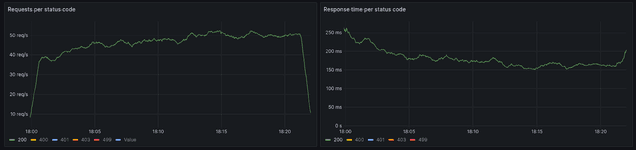
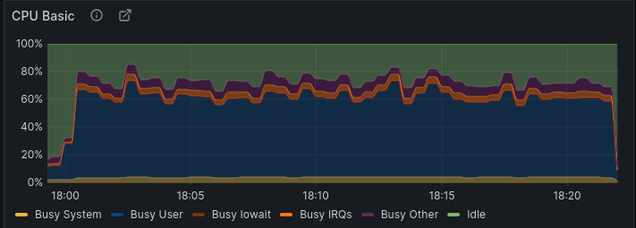
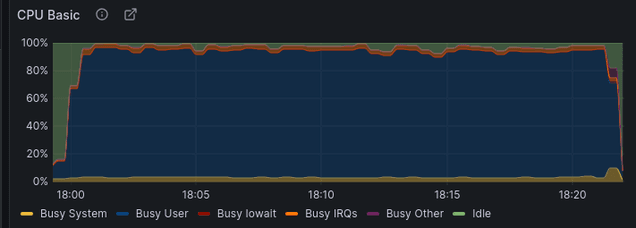
These tests show us that this version is more performant than the v25. The response time is decent (average of 200ms) and the two nodes cluster used for these tests has a great behavior on the CPU usage.
Higher activity
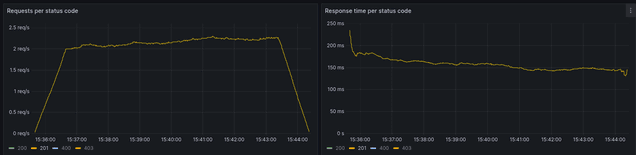
Let’s try now to expose the deployment to a higher activity (70 requests per second).
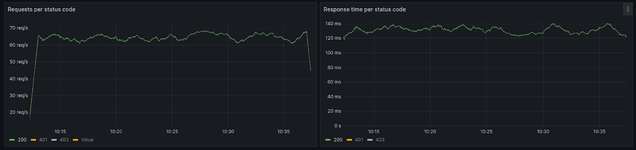
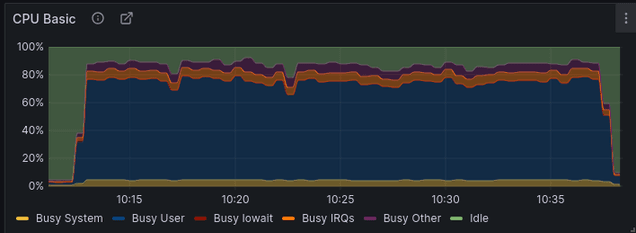
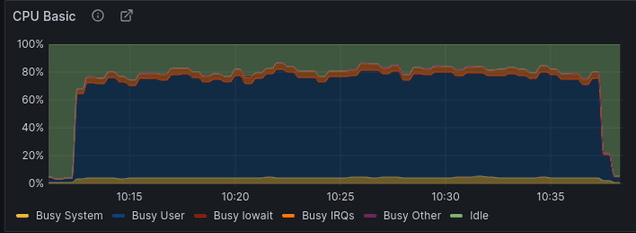
The deployment performed well, even with 70 requests per second, the cluster managed well the requests sent as the distribution highlights that the CPU usage is lower than 80% with a 130 ms response time. We are confident that upgrading to Keycloak v26 will not negatively impact your deployment's performance.
Already a Cloud-IAM customer? Let us know if you want to update your deployment to the latest Keycloak version. Check first our documentation to be aware of all the prerequisites needed for this improvement and contact our support to perform this update.